Credentialing 101: How provider credentialing works at a healthcare facility (plus expert tips)
September 30, 2026
This resource is an introduction to healthcare credentialing—specifically, physician and advanced practice provider (APP) credentialing at a healthcare facility. It covers basic credentialing terminology, walks through the medical credentialing process step by step, and includes tips from a credentialing technology expert on avoiding delays that trip up most healthcare organizations.
What is physician credentialing?
Credentialing is the first step to putting a physician to work at a facility. It's how employers verify that an applicant is who they say they are and that their credentials are legitimate. Do they meet the requirements to be on staff at your facility?
The credentialing process includes verifying information such as:
Education and training
Residency
Licenses
Specialty certifications
Qualifications
Career history
This is done through a process known as primary source verification (PSV), where the organization doing the credentialing contacts the original source to confirm the information the applicant provided is accurate.
“Credentialing exists because of patient care and quality,” says John Bou, president of Modio Health, a CHG Healthcare company that builds credentialing software for hospitals and health systems.
Where does credentialing start?
Although the credentialing process is initiated by the credentialing organization, it ultimately starts with the provider. Physicians are responsible for getting the required information to the person overseeing the process—usually a designated credentialing expert, such as a medical staff coordinator at larger facilities or a practice manager or business office manager at smaller facilities and private practices.
How long does the credentialing process take?
Credentialing can take anywhere from several weeks to several months, depending on the healthcare organization's processes, payer requirements, the applicant's background, and the completeness of the application.
The standard timeline is 90 to 120 days. With the right credentialing technology in place, we've seen organizations cut that time by 30% to 70% without sacrificing quality.
What can derail the credentialing process?
One of the biggest challenges in credentialing is incomplete applicant information. When a credentialing expert receives partial or missing information, it creates back-and-forth that slows the entire process down.
Some organizations use credentialing software to help by archiving information so a provider only has to submit it once, no matter how many times it's needed for credentialing, privileging, or payer enrollment. Even so, the provider is still responsible for submitting complete information, and the credentialing expert is responsible for keeping it organized so the process can move forward.
“A lot of the information providers submit is repetitive,” Bou says. “We've seen physicians asked to verify their medical school 20 different times across different applications. Most of that information is either public or doesn't change, so a big part of speeding up credentialing is capturing it once and reusing it everywhere it's needed."
Overcome credentialing challenges: How to improve the locums credentialing process
Credentialing tips from an industry expert
We asked Bou, who has spent more than a decade building credentialing technology at Modio Health, what he'd tell a healthcare organization looking to speed up and improve the reliability of its credentialing process. Here are his top three tips.
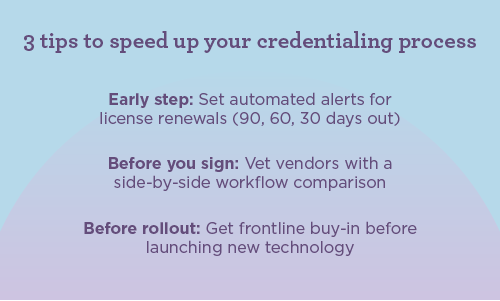
1. Set automated alerts for license and certification renewals
Re-credentialing typically occurs every 90 days to two years, depending on the organization's location. In the meantime, a physician's license or certification can quietly expire. Recredentialing re-verifies that a provider's licenses, certifications, and other qualifications are still active and in good standing—it isn't a one-time step, and missing a cycle can put a provider out of compliance.
“Automated alerts that flag 90, 60, and 30 days out are one of the best ways to keep a provider from falling out of compliance,” Bou says. “Without them, it's easy for a renewal to slip through the cracks, especially since state boards, payers, and hospital bylaws all operate on their own timelines and rarely communicate with each other.”
Automated alerts that flag 90, 60, and 30 days out are one of the best ways to keep a provider from falling out of compliance.
2. Vet vendors with a side-by-side workflow comparison before signing
Bou recommends healthcare organizations do a detailed comparison of their current process against a vendor's platform before committing to a contract.
“Almost audit how your organization works today, step by step, from onboarding a provider to getting a completed packet out to a payer,” he says. “Then check whether the vendor's workflows and integrations actually match what your team needs to produce that output. It's also worth asking about implementation timelines. We typically onboard a team in 30 to 60 days, while some other systems take six to nine months.”
3. Get frontline buy-in before rolling out new technology
According to Bou, the healthcare organizations that see the smoothest implementations have an internal advocate, someone in the day-to-day workflow, not just a C-suite mandate.
“Change management works best when it's organic, coming from the credentialing team itself rather than being handed down,” he says. “If the frontline staff who'll use the system every day aren't part of the decision, adoption suffers, no matter how good the technology is.”
Hospital Credentialing: Review by key stakeholders
Once a provider's information has been collected and verified, it goes to the medical staff committee or another governing body for review. This committee varies by facility size, but at a hospital or larger facility, it typically consists of department heads. At smaller healthcare organizations or private practices, human resources or a practice administrator usually oversees the process.
Privileging and payer enrollment
In addition to credentialing, a provider may need to undergo privileging and payer enrollment. These three processes are often confused with one another, and it's a common mistake to assume that completing one means the physician is ready to practice at your facility.
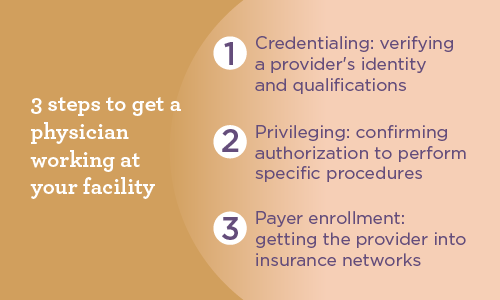
At their most basic level:

Credentialing
Primary source verification, or background check, of a provider's qualifications.

Privileging
Confirming the provider has the training, experience, and authorization to perform specific procedures at your facility.

Payer enrollment
Getting the provider enrolled in insurance plans, networks, Medicare, and Medicaid so the provider and facility can be reimbursed for services.
Don't lose money on your locums: Learn how to bill for locum tenens services
Background checks
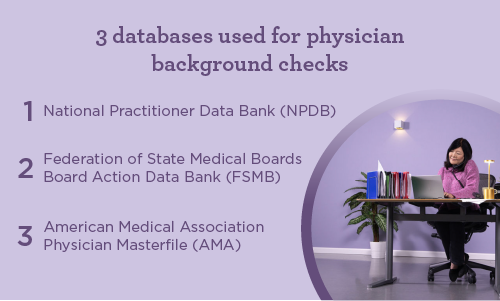
A background check is a crucial step in credentialing, even when an applicant's CV looks flawless. The three most frequently used data banks for background checks on healthcare providers are:
Background checks protect patients from unqualified practitioners and reveal any negative sanctions against a physician. Since some providers fail to disclose this information in their applications, checking these databases is an essential part of due diligence.
There are specific databases we check for red flags tied to a provider. That step is really what keeps credentialing focused on quality, not just paperwork.
Credentialing software tools
For many facilities, credentialing remains a manual, time-consuming process prone to errors and redundancy. Credentialing software tools can reduce errors, eliminate redundant data entry, and speed up the process. They also help organizations keep providers compliant so they can continue practicing and billing, using automated alerts to notify a medical staff coordinator or HR director before a license expires.
Software tools also improve visibility into where each provider stands in the process, making it easier to spot potential delays before they push back a start date.
Frequently asked questions
What's the difference between credentialing, privileging, and payer enrollment?
Credentialing verifies a provider's identity and qualifications. Privileging confirms they're authorized to perform specific procedures at a given facility. Payer enrollment gets them into insurance networks so claims can be paid.
How long does credentialing take?
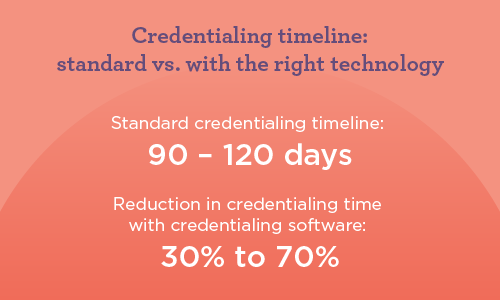
The standard timeline is 90 to 120 days, though it can range from several weeks to several months depending on the organization, payer requirements, and how complete the application is. Credentialing software can cut that timeline by 30% to 70%.
What is primary source verification?
Primary source verification (PSV) is the process of contacting the original source of a credential—a medical school, licensing board, or previous employer—to confirm the information a provider submitted is accurate.
Can credentialing software really speed up the process?
Yes. Software reduces manual data entry, flags missing information earlier, and sends automated alerts for upcoming renewals, which cuts down on the back-and-forth that typically causes delays.
What's the difference between credentialing and privileging?
Credentialing verifies a provider's identity, education, and qualifications. Privileging is a separate, facility-specific step that confirms a provider is authorized to perform certain procedures—a provider can be credentialed without holding privileges for every procedure.
What is insurance credentialing?
Insurance credentialing, also called payer enrollment, is the process of getting a provider approved by insurance companies, Medicare, and Medicaid so the facility can bill and be reimbursed for that provider's services. It's a separate process from the facility credentialing covered in this article, though the two often happen around the same time.
What is recredentialing?
Recredentialing is the ongoing process of re-verifying a provider's credentials after they've already been credentialed, typically every 90 days to two years depending on the organization and state requirements. It confirms a provider's licenses and certifications are still active before they can continue practicing.
Additional resources
For more information on the credentialing process, the following resources may be helpful:
CompHealth can help with both your permanent and temporary healthcare staffing needs. Give us a call at 800.453.3030 to find out how.